
How to score your game concept before you write a single line of code
Most developers treat marketing as something that starts after the game is built. Trailer, Steam page, content creator outreach, festivals. All of that matters. But by the time any of it is happening, most of the game's commercial fate is already decided. It was decided the day the genre and setting were chosen. This is something most developers never think about. And it's the first thing any serious marketing person looks at when they evaluate a game concept. Not the mechanics. Not the art style. Genre and setting, and whether that combination has a realistic shot at an audience. This post breaks down how to evaluate that before a single asset is made.
Genre plus setting is a marketing decision
Developers tend to think of genre and setting as creative choices. They are. But they're also the two variables that determine who will find the game, how fast they'll understand it, and whether they'll wishlist it after three seconds of trailer.
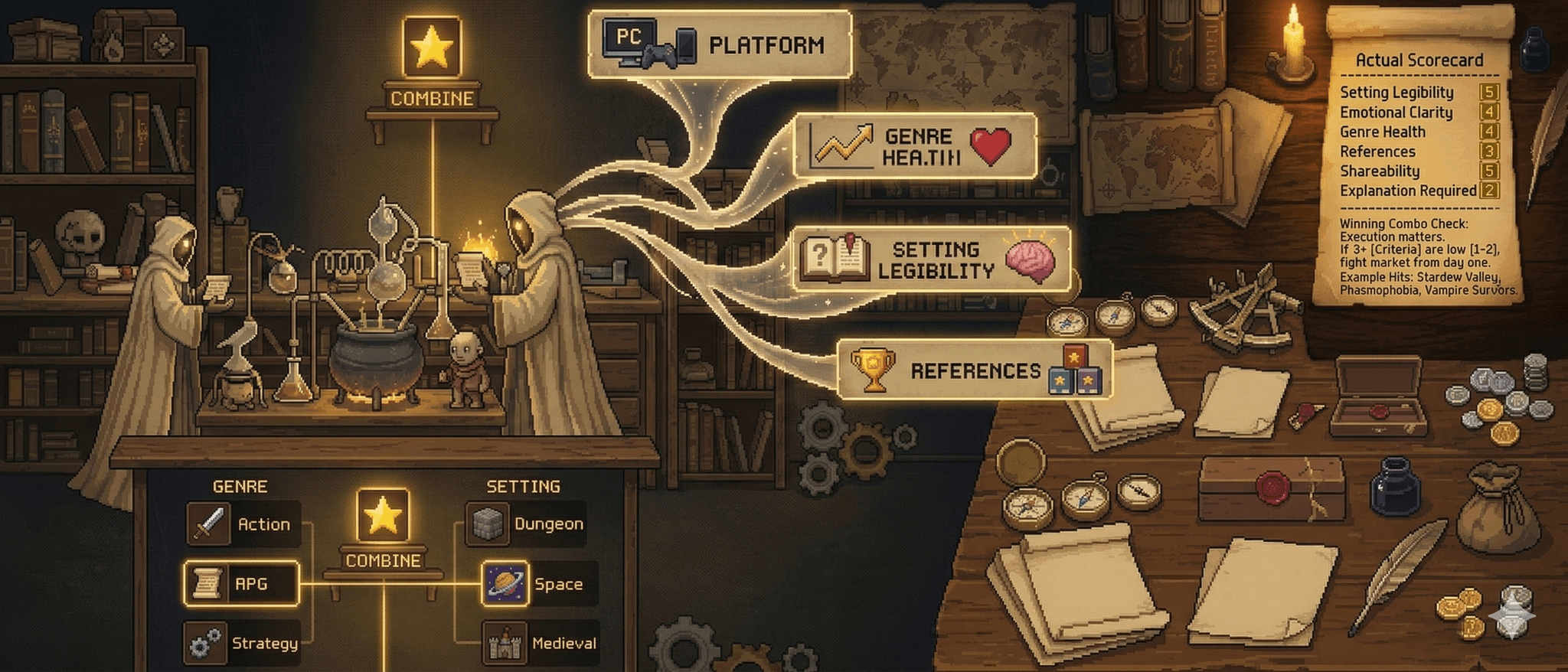
Game Dev Tycoon built an entire mechanic around this. Pick a genre, pick a topic, see how well they combine. Action plus pirates works. Dating sim plus pirates, not really. That was a game loop, but it maps to reality more accurately than most developers realize.
In reality the combination is more layered. Genre plus setting is just the surface. Below it there are at least four more things that determine whether a concept has legs.
The four layers under genre and setting
Platform. Every platform has a different audience with different habits and different willingness to pay. What works on Steam doesn't automatically work on mobile. What sells on the Nintendo eShop won't necessarily move on PC. Before evaluating anything else, you need to know whose territory the game is on.
Genre health on that platform right now. Roguelikes on PC are a crowded market. Deckbuilders too. That doesn't mean don't go there. It means the bar for differentiation is higher and execution has to be noticeably better than what's already there. Cozy games are still growing. Auto-battlers had their moment. All of this is measurable if you look at the data instead of your gut.
Setting legibility for the target audience. Not all settings land equally. Medieval fantasy is a permanent classic because decades of D&D, Lord of the Rings and AAA RPGs have done the cultural groundwork. Post-apocalypse too. But "life as a merchant in ancient Mesopotamia" is a narrower bet. You can make it work, but the audience that instantly understands what that feels like is much smaller.
References inside the combination. If there are already hits inside the genre plus setting pairing, that's a strong positive signal. The audience exists. They know how to find and pay for games like this. No references at all means either unexplored territory, which is rare, or the market already tested it and said no, which is more common.
The neuroscience part, kept short
Memory is not stored as complete pictures. It's stored in decomposed pieces: color, shape, emotion, context, all filed separately. When someone sees something new, the brain breaks it into parts and cross-references each one against what's already stored. That's recognition.
Recognition equals "I understand what this is" equals interest.
No recognition equals "I don't know what I'm looking at" equals scroll.
A game doesn't need to be explained. It needs to be shown. But what gets shown has to hook into something the player already carries in their head, or the whole thing falls flat before anyone gets to the gameplay.
Why some settings work everywhere and others don't
This is where concept scoring gets practical.
A torchlit dungeon is universally legible. A player understands the rules, tone and feel of that world in under a second. Decades of fantasy RPGs, films and tabletop games have done that work already.
An abandoned hospital works everywhere too. Dread, isolation, wrongness. The emotional package loads automatically.
Feudal Japan doesn't work universally for western audiences. For someone deep into JRPGs and anime it reads immediately as "oh, like Sekiro or Ghost of Tsushima." For someone outside that subculture it reads as a vague Asian aesthetic with no clear emotional hook. One setting, wildly different conversion rates depending on who's watching the trailer.
1980s American suburbs is a powerful nostalgia trigger for US players over 30. Stranger Things, IT, Super 8 have all primed that emotional response. For a 22-year-old player in the Netherlands it's just retro aesthetics with no personal attachment.
The dungeon lands for everyone. Feudal Japan lands only for players who already live there culturally.
This is why setting analysis is not a soft creative exercise. It directly affects how many wishlists a store page converts.
Newsletter
A premium newsletter for game studios and publishers
Deep strategy breakdowns, positioning frameworks, and practical systems for PC & console games.
$14.99/mo, cancel anytime.
The actual scorecard
Here's a basic framework for scoring a concept before development starts. Score each criterion from 1 to 5.
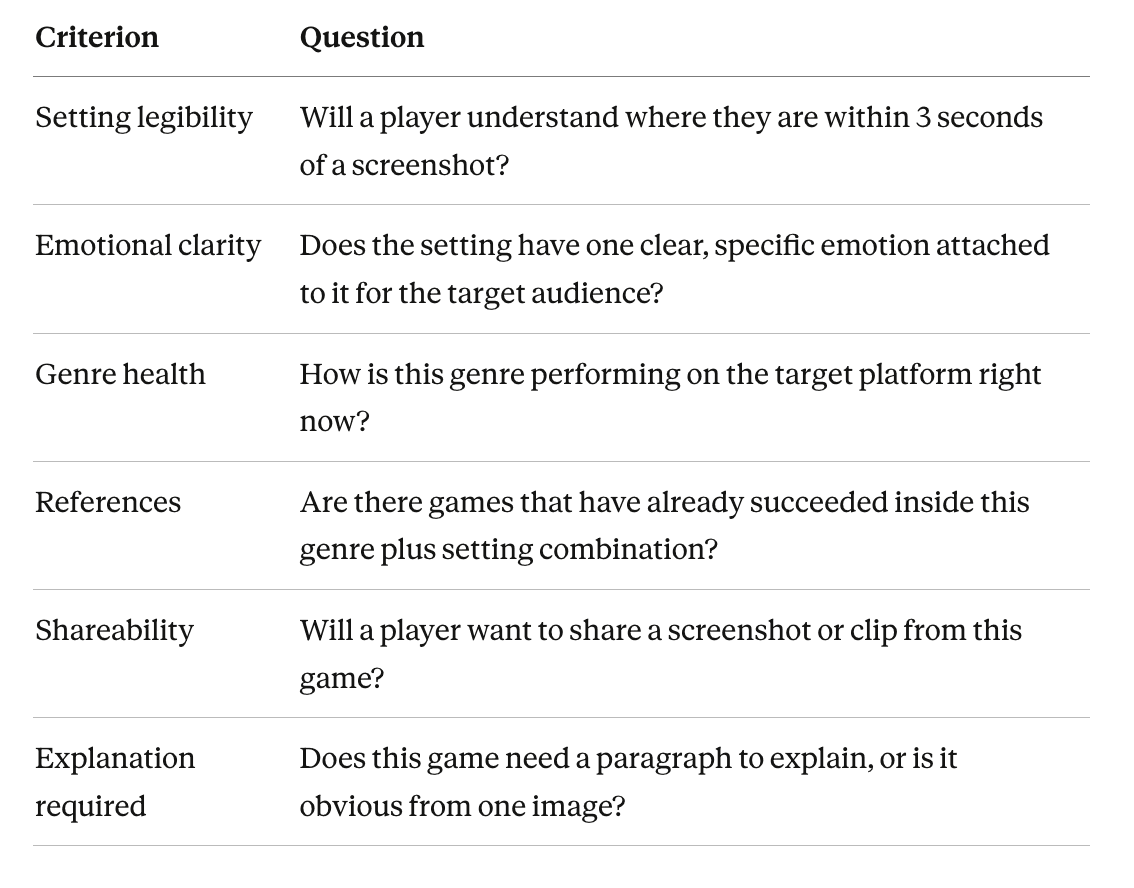
A concept that scores well on all six is not a guarantee of success. Execution still matters enormously. But a concept that scores poorly on three or more of these is fighting the market from day one, and no amount of trailer polish fixes that.
What the winning combinations actually look like
Cozy plus farming. Stardew Valley built the genre and hundreds of games followed. The market looks saturated but it keeps producing hits because the emotional hook is simple and reliable. Slow, grow, mine, my own space. Every new game here can find an audience if it finds its own voice inside that same feeling. High legibility, high emotional clarity, wide audience.
Horror plus co-op. Phasmophobia, Lethal Company, Content Warning. This combination keeps producing outsized results because horror and co-op fire two emotions simultaneously: fear and social laughter. That is one of the most naturally shareable combinations you can build. Players clip the reactions. They drag friends in. The content creates itself. Setting and genre working together to produce virality is exactly what a high shareability score looks like.
**Bullet heaven plus a recognizable skin. **Vampire Survivors proved the genre loop could be mechanically minimal and still be deeply addictive. The wave of games that followed works when the setting brings a built-in audience. Brotato has a simple but instantly distinct visual identity. 20 Minutes Till Dawn uses a Lovecraftian setting with a strong existing fandom. The genre formula is already in the player's head. The setting decides which specific audience claims it as theirs.
The game is not competing with other games
One thing worth building into how you think about concept scoring.
A game is not competing only with other games in the same genre. It is competing with everything a person could do with a free evening. Netflix. YouTube. Another hour in something they already own. Doing nothing. There is no shortage of entertainment. There is a shortage of attention.
For players over 25 this is especially sharp. Less time. Higher standards. A much shorter window to make an impression before they move on.
For younger audiences the dynamic is different but not easier. Entertainment is infinite and a lot of it is free. The upside is that when something lands it spreads fast through Discord and short-form video. But for that to happen the setting and visual identity need to be inherently shareable. Something people want to clip and send right now.
A concept that scores high on shareability is not just easier to market. It is cheaper to market.
Familiarity and originality are not opposites
The instinct to make something completely original is understandable. It's also a trap.
Complete originality means nothing for the brain to attach to. No recognition, no hook, no wishlist. Not because the game is bad. Because nobody knows what they're looking at. The best concepts find a balance. Familiar enough that recognition happens immediately. New enough that there's a reason to pick this one over the other thing that looks similar.
Hollow Knight is a metroidvania set in a world of insects. Familiar genre, unexpected setting. Strange enough to stand out, grounded enough that the brain processes it without friction.
Hades is a roguelike with an unusually strong narrative and a Greek mythology setting. Greek mythology is one of the most universally legible cultural codes for western audiences. The setting does a huge amount of work before a single mechanic is explained.
The question worth asking is not "has anyone done this before." It's "what familiar thing does this build on, and what unexpected angle does it take."
Three questions that predict whether a concept will land
Can someone tell what kind of game this is from a single screenshot in three seconds? If not, either the setting is too abstract or the genre isn't reading visually. Both are fixable, but better to know before six months of development are spent.
What specific emotion does the setting trigger in the target audience? Not "interest" or "curiosity." Those are too vague to be useful. Fear? Nostalgia? Comfort? Competitive tension? If that question doesn't have a precise answer, the target audience isn't fully understood yet.
Are there successful games inside this combination, and is it clear why they worked? No references at all means either unexplored territory or a market that already said no. Knowing which one matters a lot.
Marketing does not start with the trailer. It starts with genre and setting. Score those two things honestly before development starts, and everything that comes after gets easier and cheaper.
Is it cold and commercial and focused on what's already inside players' heads? Yes. But that's also why good games find their audience instead of dying quietly. (The money doesn't hurt either.)

I’m a marketing consultant helping PC and console studios build systems that grow wishlists and sales with clarity, not chaos.
I work with teams that want predictable growth across the full lifecycle of a game: Steam optimization, store asset improvement, messaging, analytics, creator strategy, and launch planning. My approach combines structured decision making with practical execution so developers can focus on building the game while the marketing foundation scales with them.
- Steam visibility, conversion and wishlist growth
- Store assets: capsules, trailers, messaging, positioning
- Analytics frameworks and marketing decision systems
- Creator and influencer pipeline setup
- Launch strategy for PC and console games
- Long term marketing systems, not one off tactics